Excavation Reports
2025 Report
01-12-2025 17:111. Archaeological investigations
During this year's excavation work, which took place between July 28, 2025, and August 28, 2025, the focus was on investigating an almost vertical cliff along the southwestern edge of the archaeological site and uncovering a possible retaining wall that supported the overlying soil of a terrace. In addition, the aim was to examine points on the eastern slope of the hill, which were identified in 2022 and 2023 by mapping the area using laser scanning and LIDAR (LIght Detection and Ranging) technology, as well as non-invasive geophysical surveys carried out there, such as magnetic measurements, ground-penetrating radar (GPR), and electrical resistivity tomography (ERT). The above interventions provide evidence and information about the worship and functional use of the hill more broadly, beyond the strict boundaries of the sanctuary. For the excavation works, the proposed system of the American School of Classical Studies (ASCSA) in the Corinth Excavations (Corinth Excavations Archaeological Manual) was used, along with the Harris Matrix system. Deposit Context Numbers (DCN) were determined to identify the layers.
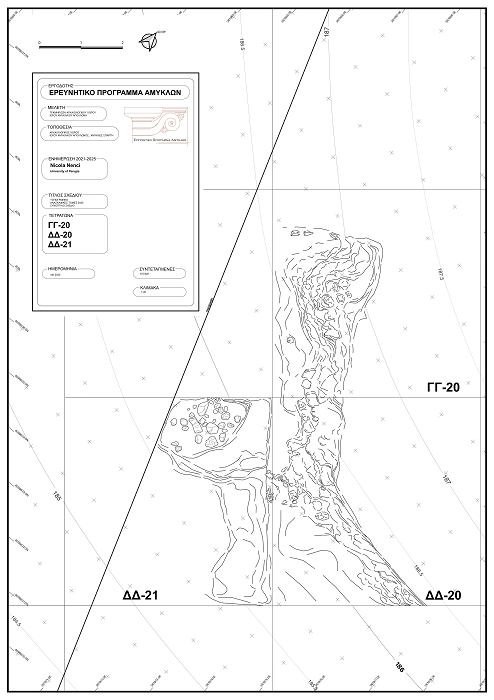
The investigation at the southwestern end of the archaeological site, in squares GG/DD -20 and GG/DD -21, was carried out under rather difficult conditions due to the peculiarity of the terrain. The aim was to uncover an almost vertical slope 2.00 m high and 10.00 m long, where parts of the natural rock were already protruding before the start of the work. After removing a thin surface layer of fill, the natural porous yellowish rock was revealed, the limestone, composed of sandstone and clayey sandstone, along the entire length of the western boundary of squares GG-DD-20. The peculiarity of this rock lies in the fact that the cliff features successive bands in which cube-shaped stones stand out. This gives the impression that the rock was worked for the purpose of quarrying almost rectangular stones. From the above, it can be hypothesized that a temporary quarry may have been formed in this area for the purpose of gathering building material for the construction of the sanctuary's monuments. It is also known that rectangular sandstone blocks are found in several sections of both the surviving base of the "throne" and the enclosure. Unfortunately, no finds characteristic of the operation of a quarry, such as tools, were found, but this is probably related to the fact that the excavations were carried out in a confined space. Less than 2.00 m to the west is the fence surrounding the archaeological site, which severely limits the investigation of the case. Finally, not enough finds were collected from the soil that was removed, which also supports the theory that quarrying activities took place in this area.
On the eastern slope of the hill and in squares DD 17-19 and GG 17, work focused on investigating a large rectangular magnetic anomaly detected in 2022 and 2023 using non-invasive geophysical methods (magnetic measurements, ground-penetrating radar/GPR, and electrical resistivity tomography/ERT). It is speculated that this is an underground, empty space. A trial trench 2 meters wide and 15 meters long was opened along the southern edge of the squares, running from west to east. The excavation work revealed, at a depth of 0.50 m to 1.00 m, with a steep slope from west to east (elevation difference approx. 5.00 m) and indications of the lithological characteristics of the rocks that determine the geomorphology of the hill of Agia Kyriaki. These parallel lithostratigraphic units consist of conglomerates, clayey-sandy, sandy, and clayey-calcareous rocks. After removing the soil, sporadic human interventions are identified. Under a thick layer of fill, which includes finds mixed up to the late Byzantine period (DCN 02), there are thin, successive layers that follow the rocky substrate and correspond to the Archaic, Geometric, and Prehistoric periods (DCN 04-05). A significant number of clay pottery and metal objects (iron spits, bronze sheets/jewelry, small aryballos, etc.), probably related to the function of the sanctuary at the top of the hill, were discarded on this side as waste in the context of sanctuary maintenance practices. At the lowest elevation level, corresponding to the easternmost square DD 19, a compact archaeological layer of small, coarse stones was uncovered. The largest volume of finds in these lower layers (DCN 06-07) corresponds to utilitarian pottery from the early and middle Helladic periods. The fact that the prehistoric settlement stretched from the top of the hill and along its eastern side is evident from the data of both the current program and those of the systematic excavation by Ch. Tsountas in 1890. From the interpretation of the above, it can be assumed that the settlement may have included this area as well, which requires further investigation and extension of the work south of this point to locate additional evidence for this first phase of use of the hill as a settlement. From the interventions in this section, on the relatively inaccessible eastern side, it appears that here too, at a distance of about 50 meters from the main sanctuary at the top of the hill, there are traces of use and exploitation of the land both in prehistoric times as a continuation of the settlement and in historical times as a place for the disposal of material from the operation of the sanctuary.
2. Geospatial data and geomorphological research
LiDAR data and orthophotogrammetric imagery were acquired over an area of 2.8 km around Amyklaio, to the west, south, and north. The flight permit was issued by the Civil Aviation Authority and ANS (Greek Air Navigation Services Provider), in accordance with European Regulations EU 2019/947, "PART A - UAS. OPEN.040 Operations in subcategory A3" and EU 2016/679, "General Data Protection Regulation (GDPR)". A DJI Matrice 300 RTK UAV/drone was used, equipped with four propellers and a LiDAR L2 lens. The flights were conducted at an altitude of 75 meters, in ground tracking mode and following a digital terrain model (DTM) downloaded from the internet to the drone's control system. The resulting data are: 1. a large number of photos taken automatically by the camera sensor, which will be merged with at least 80% overlap to produce an orthophoto of the area, and 2. a point cloud obtained through the LiDAR lens and then colored using the camera sensor. The data is being processed by the topographical department of the French School of Athens, which, due to the extremely large volume of information, will deliver a detailed technical report by December 2025. For the first time, a surface geomorphological survey was conducted in the area between the hill of Agia Kyriaki in the west—where the sanctuary is located—and the bed of the Eurotas River in the east. This work identified areas of interest and resulted in a plan for core sampling/drilling to obtain geomorphological samples. The aim is to collect new data on the evolution of the alluvial deposits of the Holocene bed of the Eurotas River over the last millennia and to present a picture of the river landscape during the periods of habitation of the area. Depending on the results obtained from these cores, the possibility of extending the research to the north and south of the area could be considered. This would help to clarify the geomorphological evolution of the wider landscape and to determine the interventions of human societies in the natural environment, both spatially and temporally.
3. Study of material
Early Bronze Age Pottery
The recording and documentation of Early Bronze Age pottery from the 2010 excavations continued during the 2025 study period. The above material comes from the northeastern part of the hill and east of the church of Agia Kyriaki. During this year, a large quantity of pottery dating mainly to the Early Helladic period was found and collected in this area. A total of 183 selected objects were recorded, photographed, and analyzed using a portable clay microscope (DinoLite digital microscope). (Registration numbers of the above objects: AM/KX499 to AM/KX681 and AM/Π105). In addition, 59 selected archaeological objects from the excavations of 2009, 2010, and 2012 were drawn by archaeologist/designer Yannis Nakas.
The material studied consists of handmade pottery, mainly from the Early Helladic period, sherds belonging to common and cooking utensils, such as bowls (very often bearing a brown-red coating or dark, usually black glaze, of the Urfinis type), basins (very often with relief decoration), baking pans, spoons, ladles, etc., but valuable objects have also been found, such as fragments that probably belong to "Faience Ware" type pots. Among the above material, one fragment stands out, which probably belongs to a part of an Early Helladic period firedog. The abundance of Early Helladic cooking pottery fragments found at Amyklaion continues to confirm the hypothesis of a settlement on the eastern side of the hill of Agia Kyriaki during the Early Bronze Age.
During this year's study period, a typology was also completed for the 539 Early Helladic period objects that have been studied so far. The typology was methodologically based on that of Lerna (see Martha Heath Wiencke, Lerna. A Preclassical Site in the Argolid. Results of Excavations Conducted by the American School of Classical Studies at Athens. Volume IV. The Architecture, Stratification, and Pottery of Lerna, 2000) and it appears that the fragments from Amyklaion have typological and decorative similarities with vessels from Lerna III (phase B-C), i.e. from the Early Helladic period II. At the end of this year's research period, boxes from the 2006, 2007, and 2008 excavations were also examined, in which a large number of Early Helladic period sherds were found, which will be studied in the coming years.
Study of Mycenaean material
Following the loss of Katie Dimakopoulou, who was responsible for studying the Mycenaean phase of Amyklaion, efforts to record and research the findings from this period began again in 2025. Based on the initial research of the excavation diaries, the relevant information was recorded and then the material was searched for in boxes from 2007-2009, 2013, and 2018. A large quantity of pottery, mainly inscribed and fine, as well as figurines, intact and partially preserved female type Ψ, as well as zoomorphic, mainly bovine, were collected. Of these, 47 objects were entered into the Amykes Research Project database, 26 intact or partial figurines and 21 pottery shards, of which 28 were photographed (18 figurines, 10 pottery shards).
Among these, a ceramic fragment, probably from a cup, stands out, bearing a red glaze on the rim and decoration on the body with a wavy line ending at the top in a rhombus with a drop in the center, and a semi-ceramic female figurine of the Ψ type female figurine with mammary protrusions on the chest and overlapping thin red lines on the body and two more intense ones on the stem. The initial data — on the one hand, a significant quantity of anthropomorphic and zoomorphic figurines and, on the other hand, fine pottery — confirm the cultic-religious use of the site during the Mycenaean period.
Study of pottery from the Archaic and Classical periods
The 2025 research on archaic and classical pottery made progress in incorporating characteristic objects into the database and completing the documentation for objects already included. A total of 124 finds were added, as well as 12 clay objects (weights, figurines, and architectural members), bringing the total number of finds (vessels, figurines, loom weight, and architectural members) from the Archaic and Classical periods recorded in the database to 1,811. A total of 181 objects were catalogued, bringing the total number of catalogued objects to 633. Photographic documentation of certain objects, which was either missing or incomplete, was also completed. In addition, the recovery, clearing, and synchronization of information in the database was carried out, making it possible to match the registration numbers from the excavations with the catalog, the photographic archive and the drawing archive of the French School of Athens, the catalog of objects photographed with the Dinolite microscope, and the catalog of objects whose samples were sent for archaeometric analysis to the Fitch Laboratory of the British School of Athens. The cataloguing of the remaining clay finds has been completed, duplicate entries have been deleted, and certain files have been supplemented, along with their photographic documentation.
The documentation from 2025 focused specifically on utilitarian pottery, with documentation of bowls from the Classical period and the early Hellenistic period, for which there is currently no typology for Laconia.
The number of miniature objects from the sanctuary has increased, bringing the total to 8,183 objects. The documentation of the typology of these vessels, which has been carried out since 2023, has been completed, and approximately 94% of the total corresponds to the type of aryballos. This progress in the quantitative recording of small vessels was made possible by the access provided by the Ephorate of Antiquities of Laconia to the findings from the earlier excavations of Tsountas, Fiechter, and Buschor.
Lead offerings
The small lead offerings under study belong to the category of the most common finds in ancient sanctuaries in Sparta and Laconia. The most famous archaeological site where more than 100,000 such objects have been found is the sanctuary of Artemis Orthia. They date from the Archaic period and feature a wide range of iconography, including humans, mythical creatures, and objects. This report covers an initial review of the material to form a preliminary general picture of these findings. To this end, all the lead offerings were gathered in a separate box in the conservation department of the Ephorate of Antiquities of Laconia and photographed in detail. A total of 270 objects were recorded, some of which are broken, with most of the finds coming from the 2023 and 2024 excavations, when the waste pit located outside the enclosure in the southern part of the archaeological site was excavated. The vast majority of the finds are wreaths, but there are also figurative motifs, such as warriors with shields and other human figures.
Paleozoological study
This year, for the first time, bone material from animals collected from two spots dating, based on the context, to the mid-6th century BC was studied: one is located in square II-7, excavated in 2023 (Deposit 3), and the other in square A1, excavated in 2019 (layer S7 and partly S8). A total of 302 bones weighing 1.6 kg were examined. Among these, 192 fragments could be identified by species, corresponding to 1.3 kg. This corresponds to a high identification rate, with 64% of the fragments and 83% of the total weight having been identified by species. The zooarchaeological analyses carried out in the laboratory correspond to methods also used in the field. The fragments were counted and, where possible, correlated. Each fragment was weighed and its dimensions, taphonomic and trace characteristics were recorded. Where the state of preservation allowed, anatomical and taxonomic identification was carried out, as well as lateral identification. This was aided by a sheep skeleton provided by the American School of Classical Studies in Athens, as well as reference manuals and online collections. Individual characteristics, such as tooth wear, epiphyseal fusion, and osteometric data, were studied and recorded. These will be incorporated into future analyses to clarify issues concerning the age at death, sex, and build of the animals. All data were recorded in a database. The assemblage shows a moderate degree of fragmentation (average weight ≈ 5.20 g per fragment. The other main limitation for anatomical and taxonomic identification lies in the frequent alteration of bone surfaces.
The study of taphonomic marks affecting bone surfaces allowed the identification of seven factors of deterioration. The most common is biological alteration caused by plant roots (42% of samples), which often prevents anatomical identification or the detection of cut marks. There are also discolorations caused by copper and iron, proving that the remains were buried in contact with metal objects. Combustion is another important factor in the analysis: the traces indicate both the roasting of meat on a spit and the more intense burning of animal parts that were probably intended for the gods (metatarsals, femurs, caudal vertebrae). Finally, manganese deposits indicate exposure to a wet and organic environment, while corrosion and gnaw marks from carnivorous animals indicate temporary exposure to the air prior to burial.
In the present study, the three species of the domestic triad were identified, i.e., cattle, sheep and goats, pigs (192 NISP, i.e., 100% of the identified fragments—Table 1). The remaining remains were classified as large or small mammals or placed among unidentified fragments. Apart from these domestic mammal remains, at least one bone, unidentified, could be attributed to a microfauna remnant whose species has not been determined.
Cattle (Bos taurus) dominate the total, accounting for 62% of identified remains and 65% of their total weight. Despite the 119 fragments, the total currently corresponds to only two animals (according to two right tibiae). The cut marks are mainly associated with slaughter practices related to consumption (disjointing, removal of meat), with one case of tendon extraction through incisions in the second phalanx. Sheep (Ovis aries) and goats (Capra hircus) occupy second place, with 33% of the remains found and 29% of their weight. As regards MNI, goats dominate the total with four animals, which were identified by four left arms. Six fragments were attributed to sheep and five to goats. The traces observed mainly relate to slaughter for consumption. However, there is also a fine incision on a foot, possibly related to scraping. In smaller proportion, the pig (Sus scrofa domesticus) is represented by only ten fragments, i.e. 5% of the identified remains and 7% of their weight, giving an MNI of only one animal at present, which is identified as female based on an upper canine tooth. Some traces related to consumption are also visible. Although a significant portion of the bones has not yet been identified, this preliminary study already highlights several trends and research directions. The distribution of species suggests a predominance of cattle, a rather unusual feature compared to other sites, which needs to be confirmed on the basis of a larger volume of data. In terms of animal exploitation, the remains bear numerous signs of slaughter and consumption, but also indications of other practices, such as the removal of tendons or skin.
The combined analysis of cut marks (cuts, notches, axe cuts) and anatomical representation will help us better understand how animals were used in the sanctuary and reconstruct the technical practices governing slaughter and sacrifice procedures. Furthermore, the burnt remains suggest that they are related to both the parts that were consumed and those that were burned on the altar.
4. Public Archaeology
As a continuation of the Amykles Research Project's outreach efforts, public archaeology activities and events were held in the village of Amykles. The first event took place on Friday, August 8, 2025, in the courtyard of the Amykles community building and served as an introduction to this year's excavation team through the narration of the fairy tale "On My Hill." This fairy tale by Ms. Chavaki was created for the educational program "Let's Play Excavation?" in the spring of 2025, for the students of the Amykles Elementary School. On Tuesday, August 19, 2025, the participants were given a tour of the village by the residents themselves. This is an activity that was established in 2024 under the title "Walking in Amykles: Our residents show us around." Members of the research team and residents of Sparta were the audience of the Amyklaeans, who eagerly shared stories and anecdotes about the village, its churches, and its historic buildings. Finally, on Thursday, August 21, 2025, in the courtyard of the Church of the Virgin Mary in Am Amykles yclae, the film tribute "The Dialogue of Themelis" by director Vangelis Efthymios, about the life and work of archaeologist Petros Themelis. The screening was co-organized by the Amykles Research Project, the Association Friends of Amyklaion, the Society of Messinian Archaeological Studies, and the Ephorate of Antiquities of Laconia. The scientific and research legacy of Angelos Delivorias in the field of archaeology, and in particular his research on the sanctuary of Apollo Amyklaios in Sparta, was highlighted at the International Symposium held on August 28 and 29 at the Cultural Center of Sparta under the auspices of the Archaeological Society of Athens. On this occasion, as well as the 20th anniversary of the Research Project, scientists from France, Germany, Italy, Sweden, and Greece presented their current research, emphasizing that Amyklaion is included in the global map of study and interpretation of Greek and Roman antiquity. The symposium was made possible thanks to the practical support of the Municipality of Sparta, the Region of Peloponnese, the University of Münster, and the Cultural Center of Sparta. Finally, the 20th anniversary of the Amykles Research Project was celebrated with a concert by songwriter Phoivos Delivorias, nephew of Angelos Delivorias, in the garden of the Sparta Archaeological Museum. The event was co-organized by the Ephorate of Antiquities of Laconia, the Municipality of Sparta, and the Mystras Palace Hotel.
With the support